

The Big Picture
- The incident: A Zeekr 9X owner from Henan drove into Kazakhstan on July 16 and watched his infotainment system lock itself
- Why it happened: Zeekr’s anti-theft geofence targets gray-market resellers exploiting a 5x price gap between China and overseas markets. But it fired on an actual customer.
- The fix: On July 26, Zeekr launched a self-unlock app button, announced an OTA making the geofence opt-in and default-off, and set up a 24/7 overseas hotline.
The Moment the Screen Went Blank
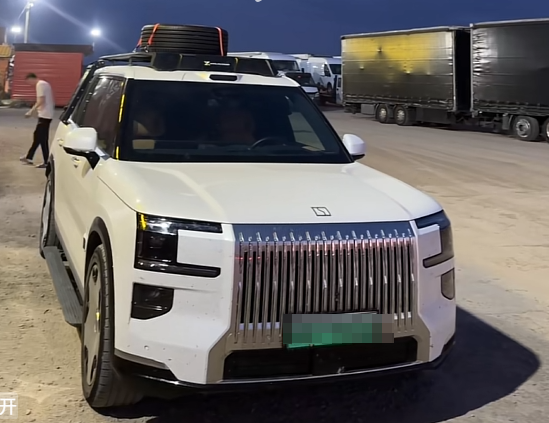
On July 8, a man named Liu packed his family into his six-month-old Zeekr 9X — a flagship SUV he’d paid roughly RMB 500,000 ($69,000) for — and started driving west from Henan province. The plan was ambitious and familiar to anyone with a sense of adventure: cross Central Asia, reach Europe, and do it on his own timeline. The kind of trip a car with a 900V platform, AI digital chassis, and enough range to make charging stops a formality is supposed to make possible.
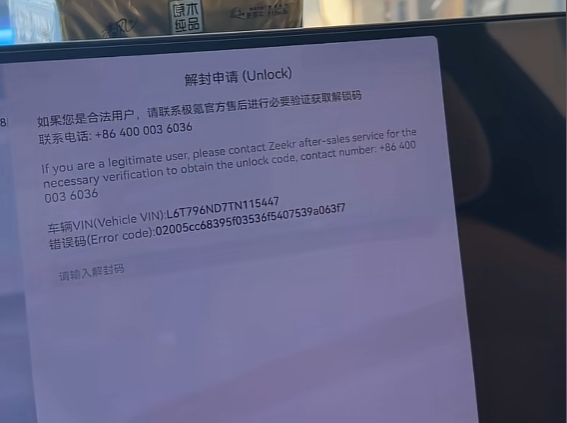
Eight days later, on July 16, he crossed into Kazakhstan through the Khorgos Port in Xinjiang. That’s when the screen in his Zeekr 9X lit up with something he hadn’t seen in six months of ownership: a full-screen “Unlock Application” prompt. Navigation: gone. Music: gone. The electronic glove box — where his cash and documents were sitting — refused to open. The fuel filler door locked. All that remained was basic driving: the powertrain, brakes, and steering still functioned. For over 30 hours, Liu’s RMB 500,000 SUV was, in his words, “a half-wreck.”
His dealership, which he’d visited for pre-trip maintenance, had never mentioned this might happen.
Six Documents, 30 Hours, Zero Warning
The fix, as Zeekr customer service told him over the phone, required uploading a stack of documents: customs clearance records, passport, vehicle purchase contract, invoice, international driver’s license, and visa. Even after submitting everything, the unlock didn’t come immediately. Liu spent more than 30 hours in a foreign country with a car that drove but couldn’t navigate, couldn’t play music for his kids in the back, and couldn’t open its own fuel door electronically. (There was a workaround — long-pressing the hazard light button for five seconds would physically release the fuel cap — but nobody had told him that before he left.)
The customer service explanation, reported by Chinese media outlet Cover News on July 22, was blunt: “Vehicles purchased in China can only be used in China. Without authorization, vehicle functions cannot be used abroad. Locking the system is to prevent the car from being resold or stolen.”
Even more troubling: customer service confirmed there was no way to pre-register for cross-border travel. The geofence triggers automatically. You find out when the screen locks. And if you’re crossing multiple borders — Liu was heading to Europe, not just Kazakhstan — the system could re-lock at each new country.
The Price Gap That Created This Mess
The anti-theft mechanism isn’t paranoia. It’s a response to a very real problem created by the staggering price differential between Chinese-market EVs and their overseas equivalents.
The Zeekr 009 — the brand’s luxury MPV — sells in China for roughly RMB 439,000 ($60,500), according to CarNewsChina’s July 23 coverage. In Singapore, that same vehicle lists for S$342,999 (~$255,000). The math is brutal: a 4–5x markup creates exactly the kind of arbitrage opportunity that attracts gray-market exporters, illegal resellers, and cross-border smuggling operations.
Geely’s Zeekr brand has built a premium positioning overseas precisely because those price gaps exist. The brand’s average transaction price sits at $53,000 globally, according to Autonewgen, with some customized 9X models from German tuner Mansory priced above $400,000 in overseas markets. Zeekr delivered 77,000 vehicles in Q1 2026, up 86% year-on-year. Protecting the overseas pricing structure isn’t optional — it’s existential.
But the mechanism that protects that structure is the same one that left an actual customer — not a smuggler, not a reseller, just a guy on a family road trip — stranded at the Kazakhstan border with a car that forgot it was his.
July 26: The Fix Lands — Fast
Zeekr’s response was faster than most Chinese automakers manage in a PR crisis. On July 23, the company issued its first statement to Chinese media, confirming the security mechanism had triggered and clarifying that core driving functions were never disabled. But the real action came on July 26, when Zeekr posted a full statement on its official Weibo account, signed with language that reads like a company that actually listened:
Zeekr Official Statement — July 26, 2026
“Real security shouldn’t be a unilateral ‘I think so.’ It should be an understanding where ‘you are in control, and I protect.'”
The three changes, as reported by Tencent News and verified against Zeekr’s official Weibo post:
1. App Self-Unlock — Live July 26. The Zeekr app now has a “Cross-Border Guardian” (跨境守护) button. Tap it, get a verification code, and unlock the car yourself. No more document submissions to customer service.
2. Default-Off Switch — Coming via OTA. Zeekr is developing a “Cross-Border Guardian toggle” that will ship as an over-the-air update. Critically, it will default to off. Drivers who want the anti-theft protection can manually enable it before crossing a border. Drivers who just want to drive their car into another country won’t need to do anything at all.
3. 24/7 Priority Hotline. A dedicated channel (400-003-6036) was added for owners already overseas or about to cross, with priority routing and emergency remote-assist capability.
The speed is notable. From July 22 (first media report) to July 26 (app update live): four days. From July 16 (the incident) to July 26: ten days. For a car company — any car company — that’s a land-speed record for software response.
This Isn’t a Zeekr Story. It’s an Export Story.
The Zeekr lockout is one bad owner experience. But the pattern it exposes is industry-wide. Chinese automakers exported 499,000 NEVs in June alone, a 153% year-on-year surge, according to CPCA data cited by CnEVPost. More than half of China’s passenger vehicle exports are now electrified. Brands from BYD to NIO to XPeng are pushing into Europe, Southeast Asia, the Middle East, and Latin America. Every single one of them faces the same tension Zeekr just ran into at 100 km/h: software built for a domestic market colliding with the reality of an international one.
In China, a car rarely crosses an international border. In Europe, crossing a border is Tuesday. A Kazakh road trip, a weekend in France from Germany, a business trip from the Netherlands to Belgium — these aren’t edge cases. They’re the default use pattern for any vehicle sold in the European Union. If Chinese automakers want to sell cars in Europe — not just ship them there, but actually build a brand — the software stack needs to handle borders as gracefully as the hardware handles autobahns.
The issue isn’t that geofencing exists. Tesla, BMW, and Mercedes all have location-based anti-theft systems. The issue is that Zeekr’s — and likely other Chinese manufacturers’ — was invisible, inescapable, and completely alien to the concept of a border-crossing continent. That combination is lethal to the premium-brand ambitions Geely has spent years cultivating for Zeekr.
Author’s Take
Zeekr deserves credit for the speed of its response — four days from media blowup to app update is genuinely impressive by automotive standards, where a recall communication plan alone can take weeks. But the fact that this fix was necessary at all tells you something about the organizational blind spot at play.
Somebody inside Zeekr’s product team designed a geofence that couldn’t be pre-registered. Somebody in legal approved a system that locks a paying customer’s glove box in a foreign country. Somebody in customer service wrote a script that says “vehicles purchased in China can only be used in China.” Nobody in that chain seemed to connect the dots to the company’s own export ambitions — ambitions that delivered 77,000 vehicles in Q1, that put a Zeekr 9X on a stage in Australia and a Zeekr 009 on a price list in Singapore, and that are central to Geely’s global growth thesis.
The Cross-Border Guardian fix is good. The real test is whether every other Chinese automaker with export ambitions is doing the same audit right now, before their version of Mr. Liu gets stranded. Because someone will. And the next time, the internet won’t be as patient.
The Bottom Line
The Zeekr 9X lockout is a $69,000 reminder that Chinese EV exports are a software problem, not just a hardware one. The cars are good enough — the 9X’s 900V platform, the premium interiors, the performance specs all clear the bar. But a single geofence toggle that nobody thought to tell the customer about can undo all of it in 30 hours at a Kazakhstan border crossing.
Zeekr fixed it in ten days. That’s the right speed. What matters now is whether the rest of the industry learned the same lesson at someone else’s expense — or whether they’ll wait to learn it at their own.
Sources & Further Reading
- CarNewsChina — “Zeekr 9X Owner Stranded Abroad: Remote Lockout Disables Smart Features for 30 Hours” (July 23, 2026)
- Tencent News / Zeekr — Full Official Statement: “关于境外自驾车机提示及后续优化的说明” (July 26, 2026)
- Beijing News / 新京报 — “极氪优化海外自驾车机限制:上线一键解锁功能” (July 26, 2026)
- BigGo Finance — “Zeekr Responds to Overseas Lockout Controversy” (July 23, 2026)
- Autonewgen — “Zeekr’s $53,000 Average Price Shows China’s Luxury EV Race Is Changing” (2026)
- CnEVPost — “China NEV Retail Sales Fall for Sixth Month as Exports Surge” (July 2026)